

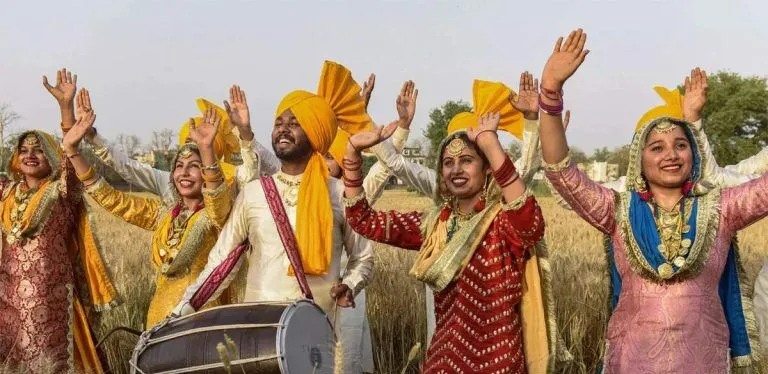
Vaisakhi is a major religious and cultural festival celebrated annually on April 14. Originally, Vaisakhi was an ancient spring harvest festival celebrated in the Punjab region, where farmers gave thanks for a plentiful crops. For Sikhs, it is the most important date on their calendar, marking the birth of the Khalsa.
The festival gained profound religious meaning for Sikhs in 1699. Following the execution of the ninth Guru, Guru Tegh Bahadur, by the Mughal Emperor Aurangzeb for refusing to convert to Islam, his son, Guru Gobind Singh, founded the Khalsa (Order of the Brotherhood).
During a large gathering at Anandpur Sahib, Guru Gobind Singh asked for volunteers willing to sacrifice their lives for their faith. Five men from different castes and regions stepped forward. They were initiated into the Khalsa through an Amrit Sanchar (baptism) ceremony and became known as the Panj Piare (“Five Beloved Ones”).
Afterwards, Guru Gobind Singh unveiled the tenets of the Sikh faith, which have been universally adopted. These are: wearing the 5 Ks or physical symbols of the faith: Kesh (uncut hair), Kanga (wooden comb), Kara (steel bracelet), Kachera (cotton undershorts), and Kirpan (sword); equality in names to eliminate caste distinctions, with all men taking the last name Singh (“Lion”) and all women taking the last name Kaur (“Princess”).
With these rites, the Sikh Identity was visibly formalized and solidified Sikhism as a collective, unified faith. The creation of the Khalsa aimed to form a “saint-soldier” community that rejected the caste system and fought against oppression. While some calendars place the New Year a month earlier, Vaisakhi is widely celebrated as the start of the Sikh religious and solar year.
In 1801, Ranjit Singh was proclaimed Maharaja of the Sikh Empire to coincide with Vaisakhi, creating a unified political state.
In modern celebrations of Vaisakhi, Sikhs visit the Gurdwara to worship, listen to kirtan, and join community prayers. A Nagar Kirtan is held with colorful street processions led by five people representing the Panj Piare, featuring singing, scripture, and sometimes Gatka (Sikh martial arts). A free community meal is served to all people regardless of their background, reflecting the core value of selfless service (Seva).
Energetic traditional folk dances like Bhangra and Giddha are performed to celebrate the joy of the harvest. Just as importantly, yellow and orange colors, representing the ripe wheat fields and the spirit of sacrifice, are prominently worn during festivities.