

By Sharan Gahunia
HOUSTON: An immigrant is someone who leaves behind everything familiar — their home, their culture, their community — to start over in a new country. It’s not just about moving to a new place; it’s about building an entirely new life in search of opportunity, safety, and freedom.
So why do immigrants come to America?
The simple answer — and the most powerful one — is family. They come so their children can have a better life than they did.
My own family’s story spans continents — from Africa to India, to London, and finally, to America. My parents once had a successful business in the United Kingdom, but racism was rampant in the late 60s and 70s. My father realized that if he wanted his family to be able to migrate to America- and truly thrive, he’d have to find a place where we could build a future with fewer barriers. So he left everything he knew — his education, his friends, and the life he’d built — and took a leap of faith toward America.
He arrived here with just two dollars in his pocket and an unshakable spirit. Thankfully, the Punjabi community, known for its warmth and solidarity, welcomed him with open arms. One local Saini family offered him a place to stay while he got settled. And as anyone can imagine, living in someone else’s home — even for a short time — takes humility and sacrifice. But that’s what being an immigrant is all about: enduring the uncomfortable in pursuit of something greater.
My father was always larger than life — a true social being with a personality as big as Texas. He made friends easily, created community wherever he went, and carried a natural leadership that people gravitated toward. Though he faced hardship, he turned every challenge into connection and every stranger into family.
The beginning wasn’t easy — in fact, it was incredibly difficult. Those first few years, all five of us lived in a small one-bedroom apartment. We sacrificed birthdays, presents, and even some Christmases while my parents worked tirelessly toward their version of the American Dream.
My dad worked long day shifts at Burger King while studying real estate on the side, determined to create something better for us. My mom, meanwhile, worked night shifts at Dunkin’ Donuts, all while caring for three children — one of whom had special needs.
My sister was born with cerebral palsy and was completely dependent on others for even the simplest things. You can only imagine the stress that filled our little home. My parents were doing everything they could to survive — in a new country, with no family nearby, no safety net, and barely enough money to get through the month.
The pressure was immense. For many immigrants of that generation, alcohol became a coping mechanism — a way to numb the pain of isolation, fear, and exhaustion. My father was no exception. The stress of trying to provide, of constantly falling short in a system not built for us, led him to drink heavily.
There were nights when the tension at home would spill over — fights, shouting, sometimes even violence. As a child, witnessing those moments was terrifying. It’s something that shapes you quietly, deeply. You grow up fast in those environments. You learn to read the room before you speak, to measure safety in tones and footsteps.
But even through the chaos, there was love — complicated, imperfect love — and a relentless desire from my parents to give us more than they ever had.
Once my parents had saved enough from their long days and sleepless nights, they made a decision that would change the course of our family’s life — they wanted to own their own business. My dad, who had gone to real estate school, realized that there wasn’t a space in Houston where the Indian community could gather and celebrate our festivals — Diwali, Eid, weddings, and all the special moments that connected us to home. So he decided to build that space himself.
Together with a few close friends, he started a small business on Hillcroft Avenue and encouraged others to join. What began as just three Indian-owned businesses eventually grew into what we now know as over 300 establishments — a thriving South Asian hub. After his passing, the area was officially renamed the Mahatma Gandhi District — a tribute to the vision and hard work of those original pioneers, including my father, who laid its foundation back in the 1980s.
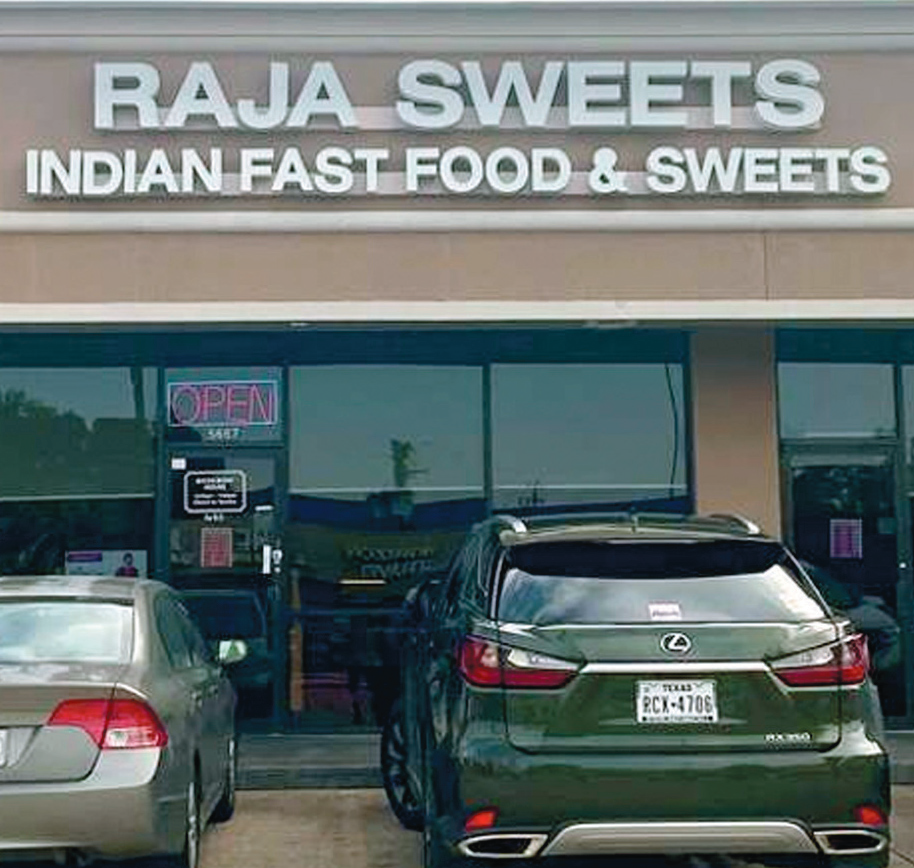
In 1986, my parents opened Raja Sweets. Before opening, they held a small religious ceremony to bless the space and prayed for the well-being of the business. They wanted to bring something authentic to Houston — sweets made fresh from scratch, just like back home. The response was overwhelming. The demand was there, and my father seized the moment. Today, Raja Sweets stands proudly as one of the most beloved Indian sweet shops in the state of Texas — but few truly know what it took to get here.
People see the success — the home we live in now, the cars we drive, the thriving business — but what they don’t see is the struggle, the sleepless nights, the sacrifices that built it. It wasn’t until the 1990s that the restaurant began to flourish as the Indian and Pakistani community in Houston grew. Around that time, my dad began sponsoring family members from India to come to America — through Raja Sweets.
In total, he brought over 50 people to this country, all LEGALLY, paying thousands of dollars in lawyer fees to give them a better life. His dream was to help each of his siblings and relatives build their own futures here — to train them at Raja Sweets in Houston, then open new branches in Austin, Dallas, and San Antonio. He envisioned a family legacy — a network of Raja Sweets across Texas.
But dreams don’t always unfold the way we hope. My father poured his savings, time, and heart into helping others, but not everyone shared his discipline or vision. When his siblings and relatives arrived, many went their own way — some partied, some drifted, some pursued different dreams. My father grew frustrated and heartbroken watching his plans unravel. Eventually, he told them all to leave, forcing them to build their own paths without his help.
The stress took a toll on him. After years of carrying so many burdens — financial, emotional, and familial — he became sick. He was diagnosed with pancreatic cancer at 57 and passed away just a year later, in 2002, at the age of 58.
His passing shattered us. My mother, who had never driven a car because my father had always kept her sheltered, suddenly had to figure out how to navigate life alone — as a widow and a single mother of three. I’ll never forget the day she learned to drive. On her very first day, she crashed the car — but she got right back up and tried again the next morning. That was her spirit. That was survival.
For a long time, I carried deep anger toward my father. Out in the world, he was admired — the president of community associations, a man of influence, respect, and generosity. But at home, it was different. He was often angry, unpredictable, and took his frustrations out on us. It was painful to reconcile those two versions of him.
Yet on his deathbed, my father finally found peace. My mother forgave him for everything — for the years of pain, the arguments, and the hardships. And as she spoke those words, he took his last breath. I think he was waiting for that forgiveness.
Even after his death, I held on to anger — until years later, while visiting my uncle in California. During a family celebration, my uncle stood up and gave a speech. He thanked my father — said he was where he was because of him. He now owned a successful restaurant also named Raja Sweets, and his success, his stability, his children’s future — all of it — was possible because of my father’s sacrifices.
It was in that moment that something inside me shifted. I realized how much my dad had carried — not just for us, but for an entire generation. Immigrants like him don’t come here for themselves — they come carrying the weight of an entire village, an entire lineage, on their backs. He paid for his siblings’ weddings, his parents’ medical bills, and the futures of dozens of others — all while trying to build his own dream in a foreign land.
He was flawed. He was human. But he was also extraordinary.
My parents were in constant survival mode — like so many immigrants are. Always fighting, always pushing through exhaustion, always doing what they could to survive another day. It’s not easy to build a life in a country that wasn’t built for you, especially when you’re working twice as hard to get half as far.
But because of them — because of their strength, their sacrifices, and their endless resilience — I stand here today. Their story is not just the story of my family. It’s the story of so many immigrant families — people who came here with nothing but faith, grit, and a dream for their children.
It’s hard not to feel heartbroken when I look at the political climate in this country — especially since the Trump era began. It hurts deeply to see how immigrants are treated, spoken about, and portrayed. Do I believe there should be immigration reform? Absolutely — just as I believe there should be gun reform. But reform should never mean cruelty, racism or bigotry.
To see immigrants — human beings — shackled and deported, torn away from their families and communities, treated as if they are less than human… it’s been unbearable to witness. It keeps me up at night sometimes. I think about how easily someone’s entire life can be defined by where they were born.
Immigrants are not the burden of this country — they are its backbone. They are some of the hardest-working, most resilient people on this planet. They sacrifice everything familiar — their language, their land, their comfort — to give their children a chance at something better. They work twice as hard for half the recognition. They bring flavor, tradition, and culture to America. They breathe new life into neighborhoods, economies, and communities.
No one leaves their homeland for fun. They come here because they dream — of safety, of opportunity, of freedom — the very same dreams this country was built upon.
Sometimes I feel a deep sense of guilt for living a life of comfort — a life my parents never had the chance to experience. They were first-generation immigrants who came to this country with nothing but determination and worked tirelessly to build a foundation for our family. Because of their sacrifices, I get to live the American dream they once only hoped for. My path has been easier because they paved it with their sweat, tears, and unwavering faith. And now, I carry their legacy forward — with the hope that I can do the same for my daughter one day.
I am the dream they turned real.
And let this be a reminder: unless you are Native American, we are all immigrants to this land. Some of us simply had an easier path here — through privilege, timing, or circumstance. But we all came from somewhere else.
So let’s not make life harder for those still chasing the same dream our ancestors once sought — a better life, a better education, a better future for their children. Because that’s what this country has always stood for. That’s what my father believed in when he came here with just two dollars in his pocket. That’s what every immigrant believes when they take that first brave step into the unknown — faith that, somehow, this country will let them build something beautiful from nothing.