

By Juhi Varma
Dilip ji Mehta was a pillar of Houston’s Hindu community, a firebrand deeply devoted to advancingSanatan Dharma. Fondly called Bhishma Pitashree, he was a true leader and patriarch of the ‘found family’ he built in the city of Houston.
Dilip Mehta left the world on April 6, 2026 at the age of 86.
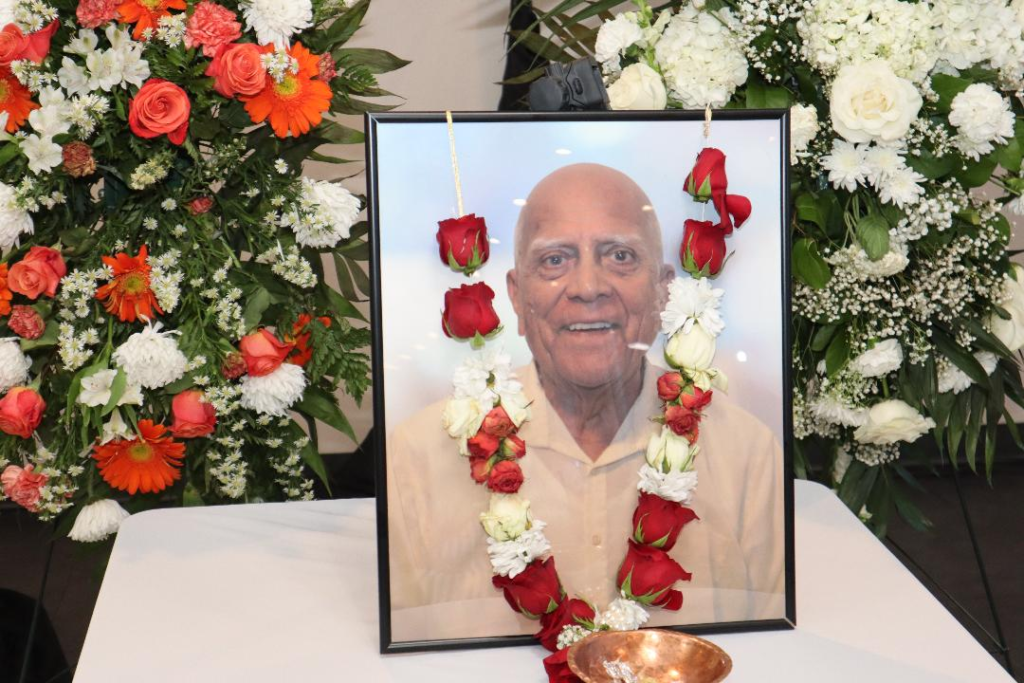
His found family came to the prayer meeting on Tuesday to, vowing to carry forward the work he set in motion.
Dilip Mehta moved to US in 1965 to study physics at the University of Kansas and started a Hindu Club in 1966. Dilip ji eventually moved to Houston, where he and his wife Kusum raised two daughters, Sneha and Nutan.
Both daughters spoke at the prayer meeting, remembering a loving and energetic father who instilled in them Hindu values and taught them the Gayatri Mantra—traditions they are now passing on to their own children. Nutan thanked everyone who had reached out, noting the outpouring of support and condolence messages received by the family following news of Dilip ji’s passing.
Community leader Achalesh Amarserved as emcee for the evening, introducing Dilip ji and the speakers while guiding the audience through a narrative that spanned from the 1960s to the present, tracing both Dilip ji’s life and the evolution of Houston’s Hindu community.
Dr. Meenakshi Parekh, whose family has known Dilip Metha and his family for 45 years, described him as an ‘angry young man’ with fire burning in every cell of his body for the Hindu cause.
“Dilip bhai was passionate about welfare of Hindus, not just in India or the USA, but all over the world, including Bangladesh and Nigeria,” she said. “He was in touch with a lot of people. He was communicating with them all the time.”
He was deeply troubled by the apathy and lack of solidarity within the community and by religious leaders who emphasized moksha and vairagya—spiritual detachment—even as Hindus elsewhere were facing persecution, Meena ji said.
Tireless and multifaceted, Dilip ji played a key role in advancing the work the Janmashtami committee, which became Hindus of Greater Houston. He was among the co-founders of the Chinmaya Mission-US, and hosted Swami Chinmayananda at his home in Boston in the sixties.
So energetic was he that he continued mowing his lawn until the age of 82. He remained in good health until the end, passing away at his computer, still engaged in work.
This same passion was evident in his professional life. At 86, Dilip Mehta was teaching at Houston Community College, and three of his colleagues attended the prayer meeting to pay tribute: Dr. Gholam Pahlavan, Dr. Cyril Anoka and Dr. Kumela Tafa.
“I knew right away (Mehta) was exceptional,” Dr. Pahalvan said.
Pahlavan said he had been wearing black in mourning for the situation in his native Iran but chose a bright tie for Tuesday evening—red and blue, printed with the periodic table.
“The tie I’m wearing today—he gave it to me during his second year at the college. I wear it in his memory,” Pahalvan said.
“Professor Mehta had a calm, welcoming presence and helped others feel comfortable through his work ethic and his ability to connect with people, he helped strengthen the learning community at Houston City College,” said Dr. Anoka. “His legacy will live on the value they represented.”
Sharad Amin, who had known Dilip ji since 1976, used a line from the popular film Dhurandar: “Ghayal hoon isliye ghaatak hoon (It is because I am wounded that I am lethal).” He described Dilip ji as “intellectually lethal,” someone who knew how to persuade and respond decisively when, in his view, dharma or the community was challenged.
Sharad ji said that witnessing the construction of the Ram Mandir was a crowning moment in Dilip ji’s life.
Suresh Patel, who met Dilip ji in 1980, recalled the early efforts to establish the Hindu Heritage Youth Camp. He said Dilip ji would arrive in his famous van carrying 20 to 30 gallons of milk along with large quantities of groceries to keep up with the children’s appetites. His daughter Nutan has twice served as camp director.
Suresh ji also recalled an occasion when Dilip ji brought Major General G. D. Bakshi to the United States. He said Dilip ji traveled to India, sought out the decorated army officer, and persuaded him to visit the US, hosting him during his stay.
Dr. Siddeswar Gubba said, “If you have to come back, Dilip ji, please choose Telangana this time, not Gujarat.”
Gajanan Gaikwad, representing the Hindu Mahasabha, said he first met Dilip ji in 2012 at the age of 25, recalling that Dilip ji quickly recognized in him the same drive to work for the Hindu cause.
Gaikwad ji said that many community leaders are engaged in faith-based service, organizing festivals, and passing traditions on to the next generation. However, Dilip ji was the only person to formally observe Hindu Memorial Day. He commemorated it on August 14, marking the period of the Partition of India when countless Hindus were brutally killed.
“In Marathi, there is a saying: ‘Let another Shivaji be born — but not in my house,’” Gaikwad ji said.
It reflects a common sentiment: people yearn for a courageous leader like Chhatrapati Shivaji Maharaj, and while they are ready to admire and support such a figure from afar, they want their own children to lead safe lives rather than face the risks that come with leadership.
“We often talk about what needs to be done to improve India,” Gaikwad ji said, “but Dilip ji took action.” Dilip ji traveled to West Bengal to serve on the ground. Instead of pursuing visiting Indian celebrities, he brought activist Tapan Ghosh to the US to engage directly with the community. Dilip ji raised Rs. 5 Lakhs for a gorakshak in Mangalore, who was killed while protecting cows.
“Our community has many Krishnas,” Gaikwad ji said, “Intellectuals who can analyze and argue, and that is valuable. But there are not enough Arjunas–warriors willing to act and fight on the ground. We called him Bhishma, but Dilip ji was an Arjuna.”
Community invited to contribute to documentary on Dilip Mehta
An effort is underway to produce a documentary on Dilip Mehta, and community members are being asked to contribute any photos or videos they may have, Vijay Pallod of HGH said at the gathering. Equally valuable are personal memories and accounts of key moments in his life that helped shape Houston’s Hindu community.