

By Ashok Rao
Let us start by imagining three scenes … separated by oceans and millennia:
Scene One:
Barbados, around 1700 AD.
Let’s step back in time into a day on a Barbadian plantation. The sun has not yet risen. The air is thick and warm. In the barracks, dozens of enslaved workers wake before dawn to the sound of a conch shell horn. Their bodies are sore from the day before; they will be sorer still by nightfall. Cane knives — long, sharp blades — hang by the door. A woman ties a strip of cloth around
her hand to prevent the knife’s handle from blistering her skin. A young boy, maybe 12 years old, grabs a bundle of rope to tie the stalks. An older man coughs; the dust of dry cane leaves have permanently damaged his lungs.
The overseer, an Englishman on horseback, waits outside. They walk to the fields. Their blades glint in the dawn light. The sun is turning sugarcane fields into a shimmering sea of gold and green. Cane must be harvested fast, before its sugar content drops. Workers swing those blades all day: chop the stalk, strip the leaves, cut it into pieces, stack and tie bundles, and lift them onto carts. The sun climbs higher. Heat
presses down. Sweat drips. There is no shade. A worker cuts too slowly; the overseer cracks a whip in the air. Sometimes striking, sometimes reminding.
By afternoon, carts filled with cane reach the mill. Inside the mill, wooden rollers crush the cane. The machinery groans. Workers feed stalks into the rollers… a dangerous task. If one’s arm gets caught, it is gone. Downstream, in the boiling house, giant cauldrons bubble with syrup. Steam fills the air. Temperatures exceed 125°F. Workers shovel fuel into the furnace, sweat dripping onto the floor. The syrup thickens. The smell of caramel fills the room.
A European overseer stands nearby, wiping sweat from his forehead, calculating profits in his account book. These profits will travel to London in wooden barrels stamped with the plantation’s logo. Outside, children gather the leftover squeezed cane fiber (bagasse) to dry for fuel. Evening comes. The cutting
stops. But the boiling house works into the night — sugar does not wait.
The sun sets. Workers return to the barracks. Some are too exhausted to eat, others whispering, telling
stories of a faraway homeland they barely remember. A cool breeze finally comes. A woman rubs her sore hands, covered in blisters. Tomorrow, before dawn, it begins all over again.
Scene Two:
London, that same year, circa 1700.
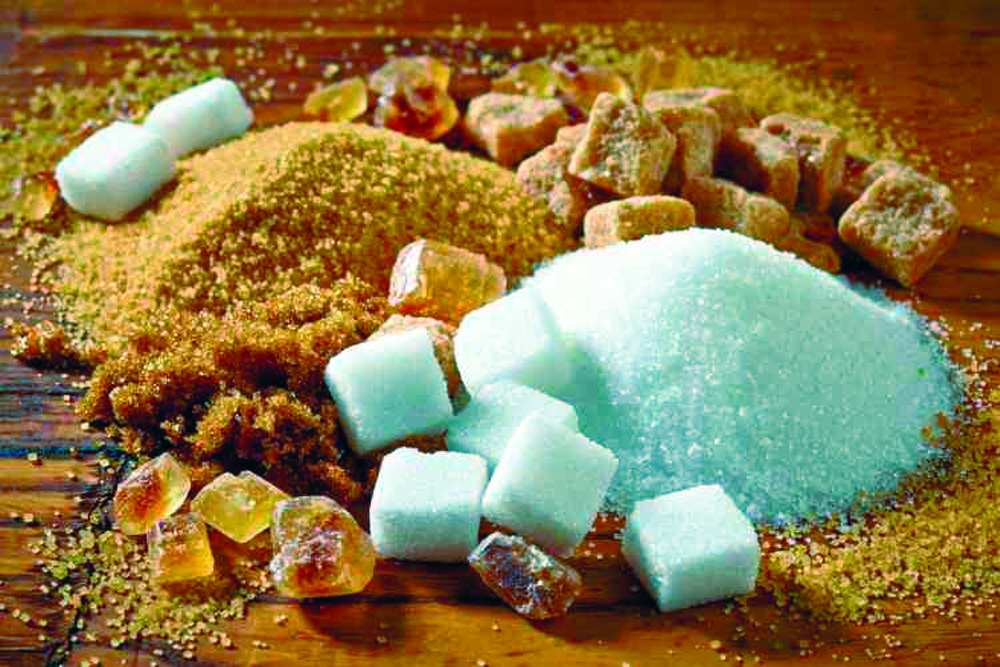
A parlor filled with embroidered cushions and polished silver. A pot of tea sits steaming on a delicate table. A silver bowl of white crystals is passed around. The crystals that were produced by those boiling cauldrons thousands of miles away. A polite clink of spoons, soft laughter, refined conversation… and not a single mention of the brutality and horror behind that sweetness.
Scene Three:
Ancient India, 2,500 years earlier.
In a village, a small pot of sugarcane juice boils over a fire. A woman stirs it patiently with a wooden paddle. Slowly, crystals begin to appear on the rim — a miracle of early chemistry. She scrapes them off and hands a tiny grain to a curious child. The child tastes it, eyes widening. Sweetness, suddenly unlocked.
These three scenes — a Barbadian plantation, a London teahouse, an Indian village — tell the story of sugar better than any single fact or statistic. Sugar is both delight and devastation; pleasure and pain; science and suffering; ordinary and extraordinary.
Origins (8,000 BC → 500 BC)
Let us begin at the dawn of agriculture 10,000 years ago; the Neolithic Age or the new stone age, a major turning point in human history, when people shifted from hunting and gathering to farming, animal domestication, and permanent settlements; a world unimaginably different from ours today.
For most of human history, sweetness was rare: honey was unpredictable and difficult to collect, fruits were seasonal and often tart, there were no candies, no desserts, no sweet drinks. When humans encountered something truly sweet, it was a rare delight, a revelation.
Sugar Originated in New Guinea
Around 8,000 BC, people began cultivating a tall, green grass that today we know as sugarcane. They didn’t refine it. They didn’t cook it. They simply cut the stalk and chewed it. Imagine that first burst of sweetness. In a world without sugar, even a mild sweet taste must have felt magical. From New Guinea, sugarcane began its long migration into India and into the great valley civilizations of the ancient world. It was in India where sugar underwent its first great transformation.
India (500 BCE → 500 CE)
2,500 years ago, Indian innovators were learning to crush cane and extract the juice, boil it in large pans, clarify it with plant ashes or lime, reduce it to syrup, and cool it until crystals formed. This was the invention of crystallized sugar — the very foundation of the global sugar industry.
The Sanskrit word for these crystals, śarkarā, traveled far and became in Arabic: sukkar, Greek: sákkharon, Latin: saccharum, Old French: sucre, and English: sugar. For ancient Indians, sugar was a medicine, a preserving agent, a spiritual ingredientm, and a luxury item. Ayurvedic texts recommended sugar for fevers, coughs, digestive issues, and wound healing. It was almost never eaten casually. It was precious.
By the early centuries AD, India had developed large-scale sugar production zones, primarily in what is today Bengal, Bihar, Maharashtra, and UP. European travelers marveled at India’s sugar-making skill. Greek generals under Alexander reported finding “a grass reed that makes honey without bees.” India had become the first global hub of sugar — but not the last. Because soon, another civilization would take sugar to a new level.
Moor Caliphate (600 → 1200 AD)
1,000 years later, around 600 AD, the Moor Caliphate expanded across the Middle East, North
Africa and into Spain. They had something incredibly powerful: no I am not referring to their great
armies and military technologies, but a passion for knowledge and agriculture.
Arab chemists revolutionized sugar-making. They introduced advanced filtration, refined crystallization, improved boiling houses, precision temperature control, and large-scale plantation agriculture. They built sugar estates from Persia, Iraq, Egypt, Cyprus to Islamic Spain. Sugar becomes a symbol of civilization in the Arab world: sugar was a medical ingredient, culinary art, a sign of refinement, was a luxury trade item.
Arab physicians — including the great Ibn Sina — the father of early modern medicine, used sugar in more than 50 medicinal preparations. Arab confectioners made syrups, sherbets, candies, candied fruits, rosewater sweets, and marzipan-like pastes. Sugar had officially become part
of daily life — at least for those who could afford it.
Medieval Europe (1100 → 1500)
European merchants tasted sugar through Arab trade routes. Fell in love with it. But Europe couldn’t grow
sugarcane. But Europeans now knew what sugar was… and they wanted more. They had to have
it. Sugar entered Medieval Europe not through bakeries, but apothecaries – as medicine.
European doctors believed sugar could balance the humors, ease coughs, treat melancholy, and relieve stomach pain It was sold in tiny amounts, often wrapped like precious jewels. But Europeans quickly realized sugar had another use: showing off wealth. Medieval nobles demanded that grand sotelties, sculpted food, made entirely of sugar, be served at their banquets … shaped like castles, knights, unicorns, ships with sugar sails, and entire biblical scenes.
But Europe had a problem: It had no tropical climate. Sugarcane would not grow there. They had to buy all of it from the Arabs at high prices. If Europe wanted sugar, it needed to find new lands and new methods. The seeds were sown for the birth of the plantation system.
Portugal & Madeira (1400 → 1500)
And it started – like so many global adventures in the 15th century – with Portugal. Before Columbus sailed west, the Portuguese were already experimenting with sugar. In the early 1400s, Portugal colonized Madeira, a volcanic island off Africa’s coast, the first modern sugar island. It was perfect for sugar. It had
hot climate, fertile soil, and abundant water. In Madeira, Portugal raised the first European-run sugar plantations. These required land, mills, skilled workers, and most importantly, massive labor forces.
Where would that labor come from? Slaves. Portuguese traders began buying slaves from the
nearby West African kingdoms. With this, the cruel and inhuman plantation model was born — monoculture farming, centralized mills, European overseers, enslaved labor and … huge profits for the mother country. This model would be exported across the Atlantic in devastating scale. When Columbus carried sugarcane from Madeira to the Caribbean, the stage was set.
Caribbean Transformation (1493 → 1650)
Columbus brought sugarcane cuttings to Hispaniola (today’s Haiti and Dominican Republic) in 1493. Spanish colonists planted fields, mills appeared, and profits skyrocketed. But it wasn’t until other European powers entered the Caribbean that sugar truly exploded.
The Caribbean had the perfect climate heat, rainfall, sunlight, fertile soils, and year-round growing seasons. This combination was unmatched. By the 1600s, the Spanish, English, French – who took Saint Domingue from the Spanish in 1697, and the Dutch had all established sugar colonies. Now the world’s center of sugar had shifted dramatically — from India to the Caribbean.
Slavery — (1650 → 1850)
Europe’s appetite for sugar kept growing. As a result, sugar becomes inseparable from one of the darkest chapters in human history. For 350 years, between 1500 and 1866: 12.5 million Africans were forcibly taken to the Americas, 2 million died en route, and millions more died under forced labor. Most enslaved Africans were brought to sugar-producing regions. This was long before cotton became the catalyst for the slave trade in North America.
The Sugar plantation was one of the harshest workplaces ever created: 18-hour workdays during the harvest, dangerous machinery, boiling houses hotter than 125 degrees, severe punishments for slowing down, minimal medical care, and high mortality. In many colonies, the average life expectancy of an enslaved person was less than 10 years. Sugar was so profitable that plantation owners found it cheaper to work enslaved laborers to death and replace them than to maintain lifetime care. This system helped build great wealth for Britain, France, Spain, Portugal and the Dutch. And American merchant cities. Sugar was not just a commodity. Sugar was a global engine of wealth, powered by human suffering.
Barbados (1650)
In 1650, Barbados became the Sugar Factory of the British Empire, the template for ever-expanding English sugar colonies. By 1680, Barbados was the richest colony in the English Empire, one of the world’s densest slave societies, and a plantation machine producing enormous profits. It was a landscape dominated by cane fields, mills, and the constant creaking of wooden rollers crushing cane. Barbadian planters became millionaires, They helped shape British laws, trade policies, and even colonial governance in North America.
To be continued.
This article is based on a history series presented by Ashok Rao on Indo-American News Radio on Masala Radio, FM 98.7. Episodes are available as podcasts on Spotify and other podcasts. Search for
Indo-American News.