
By Juhi Varma
HOUSTON — What does it take to live a joyful life? Is happiness found in material success, fulfilling relationships, spiritual devotion or simply learning to control one’s mind?
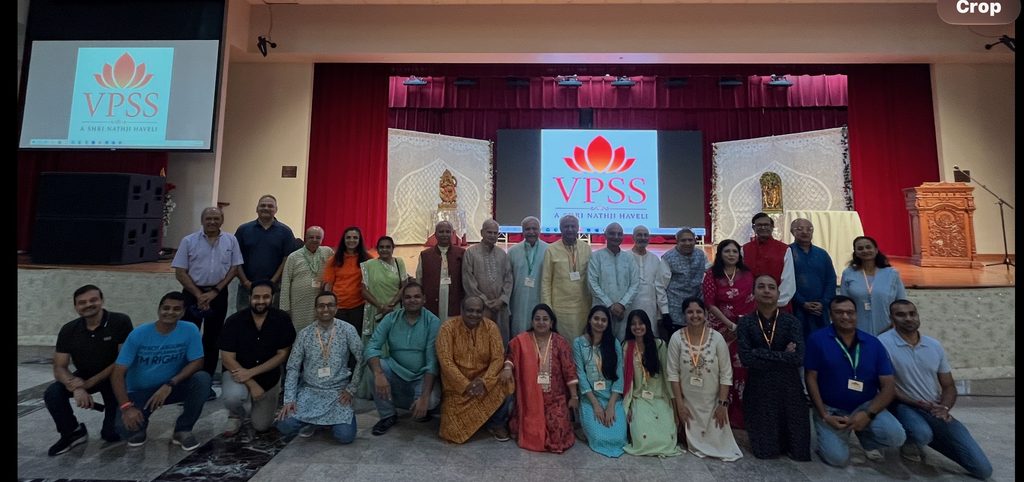
These questions were at the heart of Joyful Living Under Vedic Dharma: The Journey, a two-day seminar held at the Vallabh Priti Seva Samaj (VPSS) hall in Houston.
Main organizers included Sudhir Mathuria, Rasesh Dalal, Rajani Shah and Pradip Parikh.
“Basically, thought behind is to how do we take the true knowledge to younger generation,” said Rajani Shah.
“We put so much effort into this because we do not want the younger generation drift away from Sanatan Dharma. Money and education are there, but without this foundation they feel empty,” said Sudhir Mathuria.
“We grew up with these teachings and they gave us strength,” said Rasesh Dalal. “Now we have the means and the time, so it is our duty to create a space where our children and grandchildren can hear the same wisdom in a way that makes sense to them.”
Organized by VPSS with the support of Hindus of Greater Houston (HGH), the event brought together distinguished scholars, spiritual teachers and experts in mental health, science and personal development to explore how the ancient teachings of Sanatan Dharma can help people navigate modern life.
These included Harvard-trained psychiatrist and popular YouTube personality Dr. Alok Kanojia, spiritual teacher Shri Gaurang Nanavaty, fear management expert Dr. Arpan Yagnik and quantum physicist Dr. Mrittunjoy Guha Majumdar.
For Kanojia, better known to his millions of online followers as “Dr. K,” the seminar was something of a homecoming.
Having grown up in Houston, he recalled attending Hindu summer camps as a child, struggling with video game addiction in college and eventually discovering meditation and yoga during extended visits to ashrams in India.
Kanojia, who co-founded the mental health platform Healthy Gamer, described how those experiences transformed his understanding of the human mind and ultimately influenced his decision to pursue psychiatry.
His presentation was lively, humorous and interactive, with audience members frequently invited to answer questions.
Rather than simply telling people to overcome their ego, Kanojia explained how the mind operates through concepts drawn from Vedic philosophy: manas, the emotional and reactive mind; buddhi, the analytical intellect; and ahamkara, the ego.
He suggested that ego often develops as a defense against uncomfortable emotions such as fear, shame and rejection.
“Any time you make a comparison, your ahamkara is active,” he told the audience, explaining how people routinely measure themselves against others in wealth, appearance, education and professional success.
Kanojia emphasized that awareness, rather than immediately attempting to suppress thoughts or emotions, is the first step toward changing habitual behavior.
He said negative emotions are not inherently harmful. Fear, for example, can protect people from danger. The challenge is learning not to allow emotions to dictate every action.
Shri Gaurang Nanavaty, associated with Chinmaya Mission Houston, approached joyful living through the teachings of the Bhagavad Gita.
Life’s circumstances constantly change, and attempting to rearrange the external world to guarantee happiness is ultimately futile.
He distinguished between a higher standard of living and a higher standard of life, observing that material comforts have increased dramatically without necessarily eliminating stress.
He said we must perform our duties without being attached to the results, and to keep dharma and devotion to Krishna at the center of their lives.
Dr. Arpan Yagnik, founder of Defeating Fear, took a more hands-on approach.
He asked participants to reflect on their identities and introduce themselves to others in ways that went beyond their occupations, family relationships and accomplishments.
The exercise prompted conversations among participants, who discovered previously unknown interests, experiences and personal philosophies about one another.
Yagnik emphasized the importance of reconnecting with one’s inner voice, something he suggested is increasingly difficult amid the constant distractions of modern life.
“In this stability, you find stillness,” he said, explaining that stillness creates the clarity necessary for joyful living.
Through stories, cognitive exercises and audience participation, he demonstrated how easily people become trapped in familiar patterns of thinking.
He also addressed the challenges Indian immigrant families face in transmitting religious and cultural values to younger generations, suggesting that living joyfully and authentically may be more effective than repeatedly instructing children about tradition.
HGH President Rachana Shah echoed the importance of engaging young people.
She highlighted the organization’s work with approximately 45 temples and Hindu organizations across Houston, along with initiatives such as Hindu Heritage Youth Camp, which held three camps this year with more than 450 campers and over 60 counselors.
Shah described joyful living as the natural outcome of living in harmony with dharma.
She emphasized the four traditional aims of Hindu life — dharma, artha, kama and moksha — and said pursuing prosperity and pleasure need not conflict with spirituality when guided by ethical principles.
Applying Vedic wisdom to modern life, she said, does not require abandoning technology or withdrawing from society.
Instead, it involves making thoughtful daily choices that protect time, reduce mental clutter and cultivate lasting contentment.
Across the seminar’s varied presentations, a common message emerged: joyful living is not necessarily about acquiring more, achieving more or eliminating life’s difficulties.
It is about understanding the mind, fulfilling one’s responsibilities, maintaining spiritual perspective and learning to find peace even when circumstances refuse to cooperate.
HGH and VPSS thanked the many volunteers who made the event possible, including Dhiren Gadhia, Vrajesh Shah, Dhaval Panchal and Snehal Modi.
Next story



Readers say
Plain words and emoji. No links. Your email is checked once and never shown.