

HOUSTON: The Indian Muslim Association of Greater Houston (IMAGH) hosted a Community Wellbeing Symposium titled “Communication Across Generations” on October 3 at Bayland Community Center. The two-hour program brought together grandparents, parents, and young adults for an open and meaningful discussion about the challenges families face when different generations, cultures, expectations, and communication styles intersect. The event reflected IMAGH’s broader goal of making mental health and family wellbeing subjects that can be discussed openly and without stigma.
Rafi Ahmed, Chair of IMAGH’s Board of Advisors, served as emcee and set the tone by acknowledging a common family reality: people can deeply love one another yet struggle to understand each other. IMAGH Vice President Saeed Pathan introduced the organization’s mission of fostering amity across cultures, communities, and religions and highlighted its work with seniors, young adults, women, and families. Munir Ibrahim, Chair of the Board of Directors, spoke about IMAGH’s evolving role as a service organization and encouraged community members to provide feedback so future programs can respond to their needs.
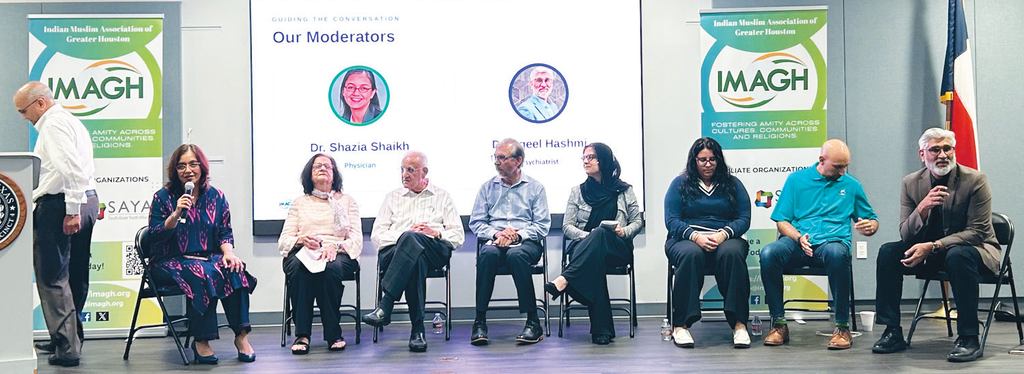
The heart of the symposium was an interactive conversation among three generations. Dr. Noor Pasha and Fateh Ali Chatur represented seniors; Dr. Shabnam Chaugle and Dr. Tahir Hussain represented the “sandwich generation,” balancing responsibilities toward both aging parents and children; and Saniya Muzumdar and Mohammed Khan represented the younger generation. The discussion was moderated by Dr. Shazia Shaikh, a geriatric and internal medicine physician, and Dr. Aqeel Hashmi, a psychiatrist.
Four questions guided the conversation: what each generation wishes others understood about them; which communication habits cause frustration; how technology helps or hurts family communication; and what makes people feel respected and heard. Audience members were then invited to participate, turning the program into a genuine community conversation rather than a traditional lecture.
Several common themes emerged. Seniors described expressing love through providing and caring rather than through words and spoke about rebuilding social connections after leaving family and friends behind. The middle generation discussed the challenge of balancing two cultures while caring for both parents and children. Younger participants emphasized wanting questions rather than judgments and stressed that being able to express emotions should not be considered weakness. Technology was seen as both a bridge and a barrier—helping families stay connected across distances while sometimes prolonging disagreements through messages and group chats.
The program concluded with practical reflections, mental-health resources, and an audience survey. Attendees particularly appreciated discussing sensitive issues in a setting that understood their cultural and faith background. The strong response reinforced IMAGH’s commitment to continuing its Community Wellbeing initiative, creating spaces where families can communicate more openly, seek help without stigma, and strengthen relationships across generations.