
By Somdatta Basu
At the IACCGH Small Business Series, Siva Yenneti and Rashmi Sheel showed business owners how to hand routine work to AI agents without handing over control
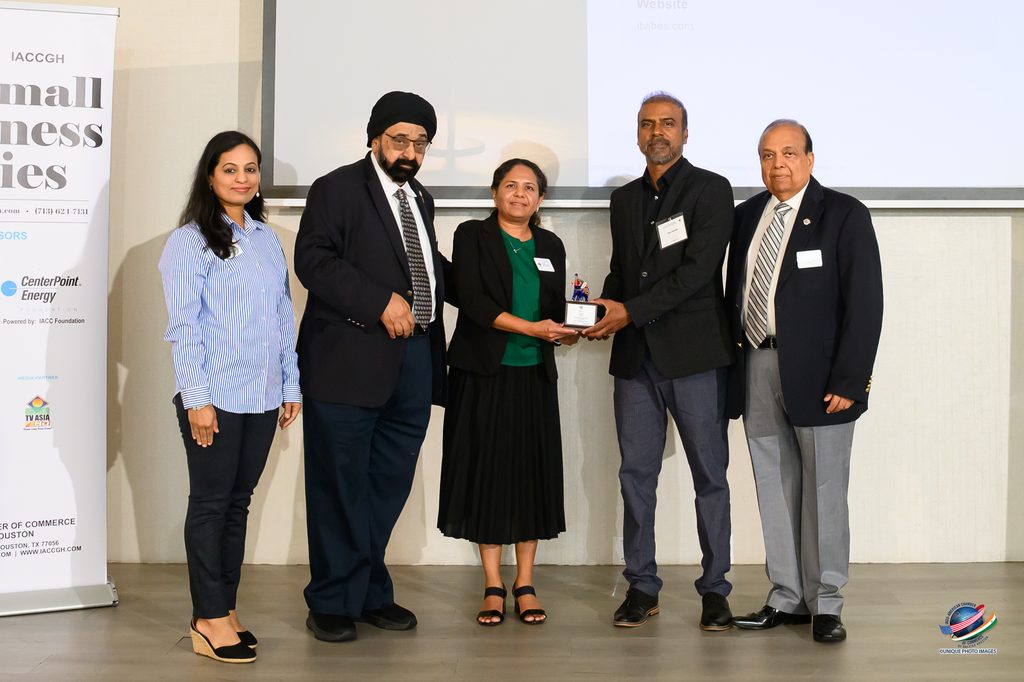
HOUSTON: Siva Yenneti began his talk by disowning the man on the screen.
“That’s not me,” he told the room at Elite Restaurant in Sugar Land on October 28, pointing to the image projected behind him. “This is the new AI avatar.” People, he explained, now send digital stand-ins to Zoom meetings, versions of themselves that speak in their tone, ask their questions, and sit through the call while the real person is elsewhere. “In maybe five, six years, we don’t know who’s real and who’s virtual.”
It was a joke, and it was also the thesis. Yenneti, President of IT Vibes, Inc., the web design and digital marketing agency he founded in The Woodlands in 2009, had come to the IACCGH Small Business Series to speak on “AI Tools and Agents: Practical Automation for Small Business.” His argument was simple. The tools are no longer coming. They are here, they are affordable, and the businesses that learn to use them will outpace the ones that do not.
He followed with a safari story. Two friends are chased by a lion, and one stops to lace up a new pair of running shoes. His friend asks whether he really thinks shoes will help him outrun a lion. “All I have to do is outrun you.” AI, Yenneti said, is the shoes. “AI is not taking your job. The guy who uses AI is taking your job.”
The program, co-sponsored by Wallis Bank and the CenterPoint Energy Foundation, was opened by IACCGH Founding Secretary and Executive Director Jagdip Ahluwalia, who framed it for owners looking to save time and focus on growth “without needing a large budget or technical skills.”
Stop learning software
Yenneti’s most provocative claim was that small business owners no longer need to master the software they depend on. The agent sits in the middle and does that for them.
His example came from the day before. His team tracks client hours in a spreadsheet on Google Drive: who requested the work, when, and where it stands. He asked his agent to read the spreadsheet, build an invoice for each client in QuickBooks, and stop short of sending them. Minutes later, the drafts were waiting for his review. “It all happened in minutes, not hours.”
The pattern runs through his whole day. Each morning, an agent reads his ten email inboxes, finds the messages he has not answered, and drafts replies drawn from each client’s history. Catching up now takes about ten minutes. When a support ticket sits for two days, an agent messages him on Slack and asks what to do. Every Friday at 8 a.m., another sends him the week’s overdue invoices, so his bookkeeper is ready.
The largest savings come from the work that used to swallow days. An agent scans the market for open RFPs that fit his business, saves them to his drive, logs them in a tracker, and drafts the response from past templates. “A sixty-page proposal or RFP document is ready in five minutes. We used to take days.” The slides he was presenting, he added, were built by AI as well.
The memory nobody has
What impresses his clients most is memory. Because his agents retain context across months of email and meetings, a report can draw on a conversation from eight months earlier. Clients tell him they cannot believe he remembered. “Almost,” he says, “but not me, but my agent.” As for remembering it himself: “I don’t know what I ate for breakfast.”
His father used to tell him to work smarter, not harder. A later generation said you had to do both. Yenneti added a third word. “Now you have to work harder, smarter, and faster,” because a competitor using AI can deliver the proposal you are still assembling. The next generation of founders are starting with these tools from day one. “They are going to eat your lunch.”
On his own team, the gains are concrete. An e-commerce build that would traditionally have taken six to eight months was completed in two to three weeks with an AI coding agent. The goal, he said, is not to hire more people but to let the same team take on more work.
His advice on where to begin was disarmingly personal. Find the task you dislike most, the one you keep pushing to the back of the list. “That’s the one I always put an agent in.” For most owners, he suggested, the first agent should manage the inbox.
He was equally clear about limits. Agents should connect only to trusted software through vetted connectors, businesses need an AI policy before they scale, and owners should work with an IT team or agency to set guardrails first.
What it looks like in practice
Rashmi Sheel, President of CMIT Solutions of Sugar Land and founder of MyAssistant365.ai, returned a month after delivering the Chamber’s September keynote on AI security, this time with case studies.
The first was the Venezuela Reawakening summit on September 17, led by José Pereira, former CEO of CITGO. With ninety days to organize it, Sheel built the event’s AI backbone: a registration chatbot, voice AI, and CRM integration. Every attendee was asked to submit a proposal describing what blocked their industry from doing business with Venezuela. AI categorized and summarized roughly three hundred submissions, briefed the moderators of four breakout groups before the event, and helped turn the results into a white paper, in English and Spanish, published within seven days.
The second was closer to home. Sheel serves on the board of Fort Bend Family Promise, which helps homeless families with children. Its staff, absorbing distress day after day, were leaving at a punishing rate. Sheel put AI on the intake line. It now handles about thirty calls a day, some at two in the morning from families on the street, and tells callers plainly that it is an AI when asked. With intake and board reporting automated, the organization has since doubled its staff, and its people spend their time on the families themselves.
The third was a Houston insurance firm with two employees doing little but sorting 700 to 1,000 emails a day. Sheel built an intake assistant on Microsoft 365 that categorizes, tags, scans attachments, and files everything in SharePoint. One staff member now reviews the work in about an hour and spends the rest of the day on marketing.
Then she let her agents speak for themselves. Her AI team, each with a name and a job spanning email, social media, sales, accounting, and security, described the work they do for her business. One reported filing 12,916 emails on its first day. Their closing lines were the ones the room carried out with them: “We run supervised. Every outgoing message is checked by her. AI writes the draft. A person decides.”
Next story



Readers say
Plain words and emoji. No links. Your email is checked once and never shown.