

By Somdutta Basu
HOUSTON: The most persuasive argument of the afternoon was made before the speaker ever reached the microphone. Opening the IACCGH Small Business Series on September 29, Executive Director Jagdip Ahluwalia told the room something chambers of commerce rarely say out loud: last year, IACCGH was breached. An intruder had created a parallel administrator account inside the chamber’s systems. The first round of cleanup removed some malicious rules, and the Chamber believed it was clean. It was not. When Rashmi Sheel was called in, she found a hidden layer underneath, where someone was still sitting inside the chamber’s controls as an administrator, free to do whatever they wanted. Removing it took her several hours across a couple of days.
“Her first-hand experience,” Ahluwalia said, “makes today’s discussion particularly relevant.”
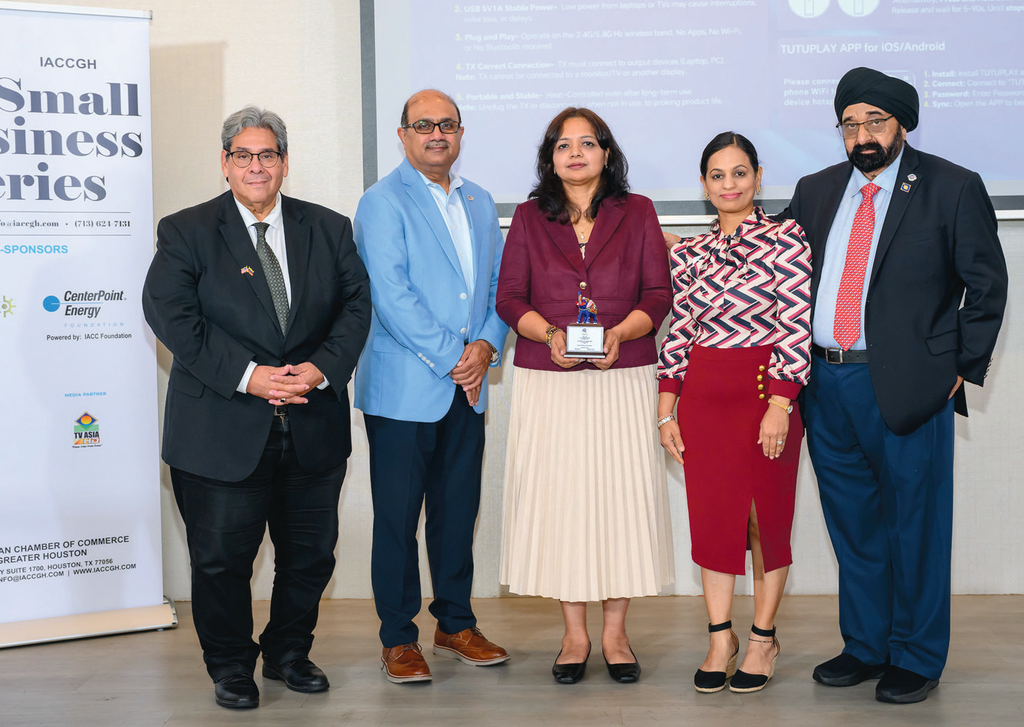
Sheel, President of CMIT Solutions of Sugar Land and founder of MyAssistant365.ai, had come to speak on “AI Is Already in Your Business: How Texas Small Businesses Can Use It Safely and Meet the New AI Law.” The program was co-sponsored by Wallis Bank and the CenterPoint Energy Foundation, and IACCGH President Rajiv Bhavsar, welcoming guests, noted the chamber’s momentum: founded in 1999, it had marked 27 years at its gala the month before and now hosts roughly two dozen events a year.
A strategist shaped by two careers
Sheel calls herself an AI and IT operations strategist, a title that reflects the two companies she runs: one for managed IT and cybersecurity, the other for AI operations. Behind them are 27 years in predictive analytics, data analytics, and ERP systems across logistics, pharmaceuticals, and retail supply chains, including core development work on Oracle Retail’s forecasting systems. In 2019, after her family moved from Atlanta to Houston, she left corporate life and launched her cybersecurity firm. When generative AI arrived, her predictive analytics background made it “a natural fit.”
Her promise to the room was threefold: how to use AI safely, how to keep customer trust, and how to automate “with confidence, not with fear.”
A law that applies to everyone
AI, she reminded the audience, is already woven into daily life through GPS, smart speakers, Amazon, Netflix, and the very email platforms businesses depend on. Avoiding it is not an option. “Fearing it will only leave us behind.”
What has changed is the law. The Texas Responsible Artificial Intelligence Governance Act, known as TRAIGA, took effect January 1, 2026, and Sheel was emphatic that no business is too small to be covered. “If you are a single-person business owner or you are an enterprise, don’t assume you’re exempt.” The law is largely intent-based, targeting AI used for criminal activity, unlawful discrimination, harmful deepfakes, or infringement of constitutional rights. It sets expectations of disclosure when people are interacting with AI, including in health care, where AI-assisted diagnosis or treatment must be disclosed. Enforcement rests with the Texas Attorney General, and individuals cannot sue under it. Sheel likened the process to “a warning ticket before a fine.”
She framed her remarks as one business owner advising another, not as legal counsel, and Ahluwalia reinforced the point: the session was informational, the rules are changing quickly, and anyone needing formal guidance should engage a professional.
Foundation before function
Her central argument was structural. A building without a foundation is a house of cards, and AI deployed without rules is no different. She walked the room through the National Institute of Standards and Technology’s AI Risk Management Framework and its four functions: govern (know your tools and what data they can reach), map (understand your systems and their risks), measure (test outputs continuously), and manage (keep humans approving anything consequential, especially financial decisions). It is a cycle, she stressed, not a one-time exercise.
Then she named the risk most businesses already carry without realizing it: shadow AI. Employees without an approved tool turn to personal accounts, often with default settings that allow their conversations to train the provider’s models. When those employees leave, company data leaves with them, locked in an account the business cannot reach. Her remedy is an approved company plan, which carries contractual protection against model training, and a careful pass through every privacy setting. When an attendee described someone photographing a customer database and asking ChatGPT to organize it, Sheel’s answer was simple: confirm it is a company account, categorize your data, and “be very careful what you paste in AI, no matter what.”
Green, amber, red
To make risk practical, she offered a traffic light. Green is ordinary chat, where you remain in control, provided nothing sensitive such as a Social Security number goes in. Amber is company data, which should be anonymized and governed by policy. Red is anything touching finance, law, insurance, or credit. She cited Amazon’s experimental recruiting tool, abandoned after it learned from a male-dominated workforce and began screening out women applicants. The greater exposure, she warned, is often not AI law at all. “It will be the contractual law that will burn.”
She also described a staircase of adoption: assisted (chatting with ChatGPT, Claude, Copilot, or Gemini), automated (workflow tools such as Zapier, n8n, and Make that call AI through APIs), augmented (desktop agents that read files, handle email, and browse the web), and agentic (goal-driven agents that spin up other agents to execute). Each step brings more reward and more risk, and human oversight belongs at every one of them.
The voice on the phone
Bad actors, she cautioned, have the same tools. Voices can be cloned, faces replicated, and phone numbers spoofed with readily available apps. A staff member who believes the CEO is on the line may move money before stopping to think. Scammers lean on three levers: urgency, emergency, and authority. Her defense was disarmingly low-tech, borrowed from parenting. Just as children are taught to ask for a password before leaving school with anyone, staff can be given a verification word and explicit permission to hang up and call back.
Every table received QR-linked handouts, including a one-page starter AI policy built around a few questions: who decides which tools are used, what data goes in, where humans must stay in the loop, what an agent may do alone, how results are reviewed, and what happens when something goes wrong.
Practicing what she preaches
As a Claude partner, Sheel admitted she approached desktop AI reluctantly, because her clients’ data was at stake. She found gaps and closed them, building roughly 27 cybersecurity skills, dark web monitoring, a secure vault so API keys are never exposed, weekly health checks on her agents, and a separate browser so the AI never touches saved banking or card details. “You fence the AI,” she said. What took her seven to eight months to build, she has since packaged into a product that can configure a secure setup in about two hours.
Her closing list was five steps any owner can begin this week: talk to your team without assigning blame, turn off model-training settings, move to a company plan, put policy and training around every financial transaction, and start a written AI policy.
When a Member Shines
The afternoon carried a second testament to her work. José Pereira, former President and CEO of CITGO Petroleum and now leading Venezuela Reawakening, described a recent energy summit that drew about 300 attendees in person and 200 online, from as far as Canada, Mexico, India, and the Caribbean. Sheel ran its technology backbone, and the summit’s white paper was published within a week. A colleague of his later stood to add that what Sheel could save a business “is beyond words.”
Asked about DeepSeek, Sheel said plainly that she would not trust it with business data, explaining that she chose Anthropic’s ecosystem for its founding emphasis on security, privacy, and ethics. Asked whether AI certifications are worth the time, she urged everyone to pick a platform and learn it deeply. “We have superpowers in our hands with AI.”
Ahluwalia closed with the line that summed up the afternoon. “When one of my members shines, the Chamber shines.”