

New partnership with Rice University’s Woodson Research Center aims to preserve the history, achievements, and experiences of Houston’s Indian American community for future generations.
By Juhi Varma
The Foundation for India Studies (FIS) has launched a landmark collaboration with Rice University’s Woodson Research Center to preserve and document the rich history of Houston’s Indian American community through archival collections and oral histories.
“For more than 15 years, we’ve been building collections related to Houston’s Asian American communities, but we do not yet have a significant representation of the Indian American community,” said Amanda Focke, Head of the Woodson Research Center at Rice University. “Today’s event marks our intention to build the collection in that direction.”
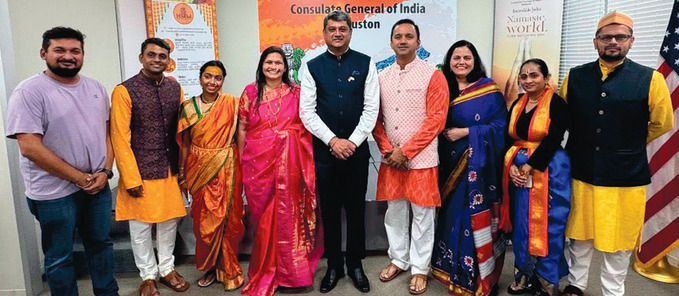
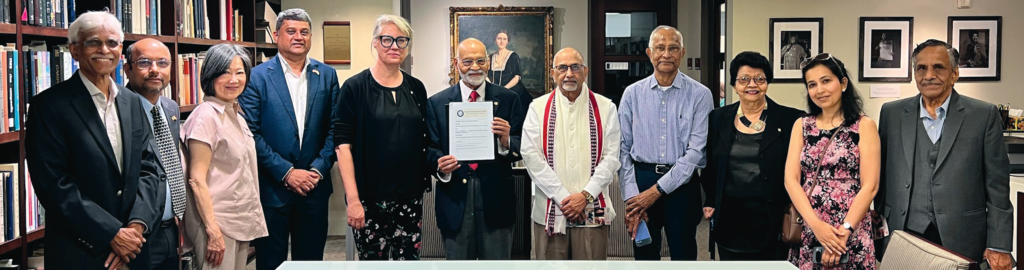
Community leaders, scholars, and university officials gathered at Rice University on June 1 for a ceremonial “setting of intentions” event marking the beginning of the partnership. Fourteen representatives from FIS and Rice University participated in discussions focused on documenting the history, experiences, and contributions of Indian Americans in the Greater Houston area.
The Memorandum of Understanding (MOU) was signed by Krishna Vavilala, Founder and Chairman of FIS, and Amanda Focke, a certified archivist and Head of Special Collections at Rice University.
“It was a great beginning for this important project,” Vavilala said following the meeting. “The Foundation for India Studies looks forward to a productive and long-term collaboration with Rice University.”
Vavilala noted that Rice University was an ideal partner because of its nationally recognized archival and research infrastructure. The project will help preserve photographs, documents, audio recordings, videos, organizational records, and personal papers for future researchers, students, and generations of Indian Americans.
The Woodson Research Center, located on the first floor of Fondren Library, is home to numerous collections documenting Houston’s diverse communities. Among its holdings are the stories of the pioneering Gee Chinese American family, Vietnamese refugees who rebuilt their lives after the Vietnam War, and Japanese American families who persevered after internment during World War II. The center also houses the Houston Asian American Archive, which preserves the experiences of Asian American communities across the region.
“You may be wondering why we do not already have extensive collections relating to the Indian community,” Focke said. “The truth is that we do have some materials. We simply want much more.”
Under the new initiative, the Woodson Research Center will collect archival materials, photographs, documents, and oral histories from Houston’s Indian American community and from nonprofit organizations serving the community. These materials will be professionally preserved, cataloged, and made accessible to researchers, students, and community members interested in understanding the history and contributions of Indian Americans in Houston.
The center itself reflects its archival mission. Visitors are greeted by historical artifacts, including an antique printing press, traditional card catalog cabinets, and other displays that celebrate the preservation of history and knowledge.
Dr. Anne Chao, Associate Director of the Chao Center for Asian Studies at Rice University, thanked FIS for bringing together many of Houston’s prominent Indian American community leaders.
“I have been contacted by journalists from across the country who want to better understand Houston’s Asian American communities,” she said.
Dr. Chao, the founder and driving force behind the Houston Asian American Archive (HAAA), has dedicated years to preserving the lived experiences of Asian and Asian American communities in one of the nation’s most diverse cities. Her work seeks to document community histories before they are lost to time.
“We found that Houston has one of the largest Asian American populations in the United States, yet there was no major repository dedicated to preserving these stories,” Chao explained. “We started modestly by interviewing a Chinese American newspaper publisher who donated his papers to us. Word spread throughout the community, and our goal has always been to create a truly pan-Asian archive.”
Consul General of India in Houston D.C. Manjunath, who served as chief guest at the signing ceremony, welcomed the initiative.
“From the Government of India’s perspective, also, we are looking at the diaspora’s success stories,” he said. “From the consulate, we would be more than happy to support and participate, and as from our side, we are also doing an oral history (contribution) from the government’s perspective.”
Vavilala highlighted the Indian American community’s contributions to Houston in fields such as engineering, medicine, technology, business, education, and culture. He noted that younger generations often know little about how temples, monuments, community institutions, and nonprofit organizations were established.
“This archive can become a central repository where future generations can learn about the people and organizations that helped build our community,” he said.
Rice University’s Department of Transnational Asian Studies works closely with the Chao Center for Asian Studies, which was established in 2008 through the support of the T.T. and W.F. Chao Family Foundation. The center serves as a major research hub for faculty, students, and postdoctoral scholars and publishes the online journal Transnational Asia. Over the years, it has received support from organizations such as the Henry Luce Foundation, the U.S. Department of Education, and the Academy of Korean Studies.
“Once materials are received by the Woodson Research Center, Amanda’s team will process, preserve, and make them available for research,” Chao said.
She added that Rice University will work closely with community organizations and individuals to identify and acquire materials suitable for inclusion in the collection.
Focke emphasized that the partnership is intended to create a lasting archive documenting the growth, achievements, and evolving story of Houston’s Indian American community.
“Thank you for your many efforts in bringing the Indian American community together and for helping launch this collaboration,” she told the gathering. “We should begin with the archives of the Foundation for India Studies itself and build from there.”
Following the signing ceremony, Focke and Chao hosted a Mediterranean lunch for attendees to celebrate the occasion. Guests also received commemorative swag bags as a memento of the event.
The initiative represents an important step toward ensuring that the history of Houston’s Indian American community is preserved for future generations. Through this partnership, personal stories, organizational records, and community achievements will become part of the historical record, providing scholars and the public with a deeper understanding of the community’s role in shaping Houston’s cultural, educational, and economic landscape.
Are you interested in sharing your story? Please call Krishna Vavilala 713-201-3383 for any further queries.